AI Didn't Replace Developers — It Exposed Who Was Really Thinking
AI tools aren't replacing developers — they're exposing the gap between those who adapt and those who don't. After training 50+ developers, here's what's really changing on the ground.
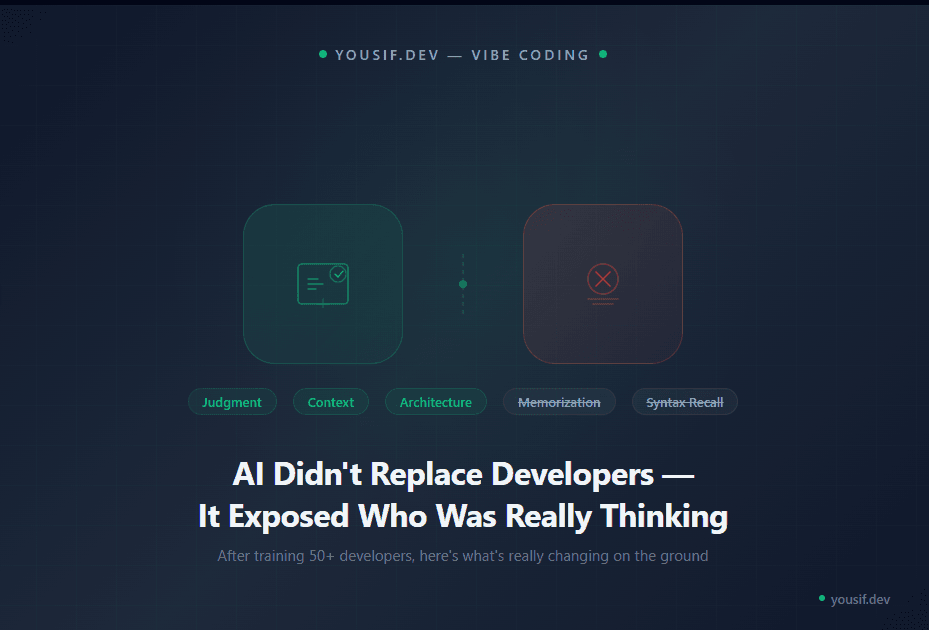
There's a conversation happening in tech right now, and it's not the one you think.
It's not about whether AI will replace developers. It's not about prompt engineering as a career. It's something quieter and more important: the daily workflow of a developer is changing — and most people haven't noticed yet.
The Old Way Had Friction Built In
Two years ago, a developer's day looked something like this: read the ticket, recall the pattern from memory, open Stack Overflow, cross-reference documentation, write the code, debug, repeat.
The bottleneck wasn't intelligence — it was retrieval. You had to know where to look, and looking took time.
That friction shaped how we taught programming. Bootcamps drilled syntax. Interviews tested recall. The "good developer" was the one who remembered the most.
What AI Actually Changed
AI didn't remove the need to think. It removed the penalty for not remembering.
That's a subtle but massive shift. When you can describe what you want in plain language and get a working draft in seconds, the skill being tested is no longer recall — it's judgment.
Can you evaluate what you're given? Can you spot the flaw in the logic? Can you direct the output toward something that actually works?
I've watched students in our bootcamps navigate this in real time. The ones who struggle aren't the ones who can't code — they're the ones who don't know what they're building well enough to verify the AI's output.
Three Patterns I'm Seeing on the Ground
1. The Speed Illusion
Developers using AI are shipping faster — but not always better. The speed is real. The understanding sometimes isn't.
I've seen entire features built with AI assistance that the developer couldn't explain a week later.
Speed without comprehension is technical debt in disguise.
2. The Context Problem
AI generates code in isolation. It doesn't know your architecture, your team's conventions, your deployment environment, or the business logic that lives only in a Slack message from six months ago.
The developer's job is increasingly about providing that context — and that requires deep system knowledge, not less.
3. The Seniors Are Getting Faster, Not Slower
Counterintuitively, the developers benefiting most from AI aren't juniors — they're seniors.
Because they know exactly what to ask for. They can describe the architecture in precise terms, catch the edge cases the model misses, and use AI as a multiplier on judgment they already have.
Juniors who skip the fundamentals don't get a multiplier — they get a dependency.
The New Core Skills
The fundamentals still matter — more than ever, actually. But the fundamentals aren't syntax anymore. They're:
Understanding how systems fit together — not just individual components, but how they communicate, fail, and scale.
Reading and evaluating code you didn't write — because most of the code you'll review will be AI-generated.
Breaking a problem into clear, specific requirements — the better your spec, the better the AI's output.
Debugging with a mental model, not just trial and error — knowing why something broke, not just that it broke.
Knowing when to trust the output and when to question it — the most dangerous code is the code that looks right but isn't.
These aren't soft skills. These are the new core skills.
The GPS Analogy
Think of it like GPS and driving.
GPS didn't eliminate the need to drive — but it did eliminate the need to memorize routes. It also made bad drivers more dangerous: more distracted, less situationally aware.
Good drivers got better. They could focus on traffic, conditions, and decisions — not directions.
AI in development is the same curve. The developers who will thrive are the ones building judgment, not just building things.
A Closing Thought
I run a bootcamp. Every cohort, I watch people arrive thinking the goal is to memorize syntax, and leave understanding that the goal is to build a mind that solves problems.
AI hasn't changed that goal. It's just made it more urgent to get there — and less forgiving for those who don't.
The shift is already happening. The question is whether you're adapting to it — or waiting to see how it lands.